


General aims
The application of artificial intelligence -AI- to medicine can contribute to the improvement of population health. This course focuses on the challenges, needs, implications and methods of artificial intelligence for public health. Designed with a transdisciplinary and interdisciplinary approach, it will allow the students to acquire knowledge in the field of artificial intelligence applied to public health, by combining algorithmic and modelling knowledge with contextualised understanding and critical thinking.
Learning objectives
This course is designed for the students to gain knowledge on the following subjects:
- The basics of public health, statistics, computer science, epidemiology, human, economic and social sciences;
- Artificial intelligence programs and tools for public health; artificial intelligence algorithms and methods;
- Programming in Python and R;
- The organisation and management of an artificial intelligence project applied to health-related data.
Core competencies
Throughout this course the students are expected to acquire the following competencies:
- Understanding the issues, needs, implications and methods of artificial intelligence for public health;
- Knowing how to respond to a public health problem by applying artificial intelligence methods, in a contextualised and critical way;
- Knowing how to implement artificial intelligence-based analyses using well known programming languages in this field, Python and R;
- Knowing how to interpret the obtained results and understanding their possible limitations;
- Being able to organise and run an artificial intelligence-based project from a transdisciplinary and interdisciplinary perspective.
Training opportunities
In the case where a student who has validated this Postgraduate Diploma PGDip/DESU applies for the MSc/Master 2 AI4PH (Artificial Intelligence for Public Health, training officers: Dr Jean-Charles Dufour, Pr Roch Giorgi), specialization of the Master’s degree in Public Health (training officers: Pr Stéphanie Gentile, Pr Roch Giorgi), the latter would capitalise only those teaching units for which he/she would have obtained a mark ≥ 10 (all individually validated TUs are accredited).
Student Testimonials
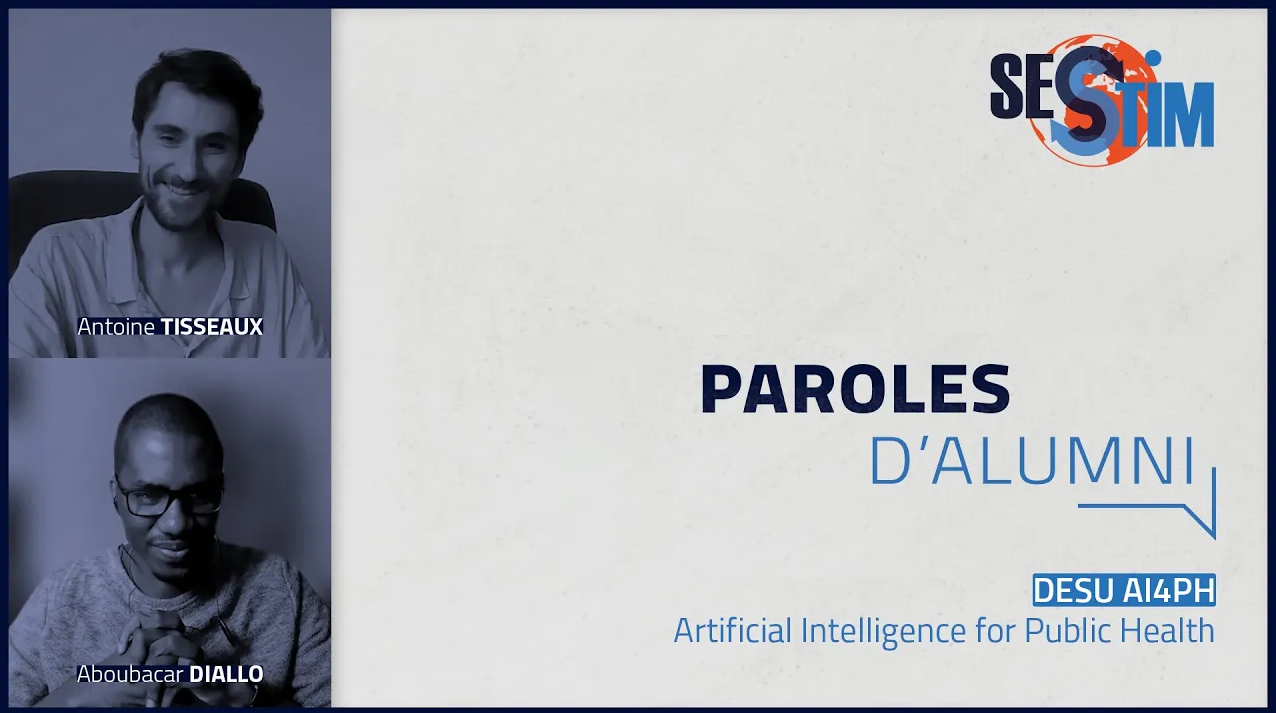
SESSTIM gives a voice to its former students in a video series called “Alumni Voices.” The students interviewed have the opportunity to share their experiences with the various programs offered by SESSTIM.
Read testimonials from former students of the AI4PH program here.